
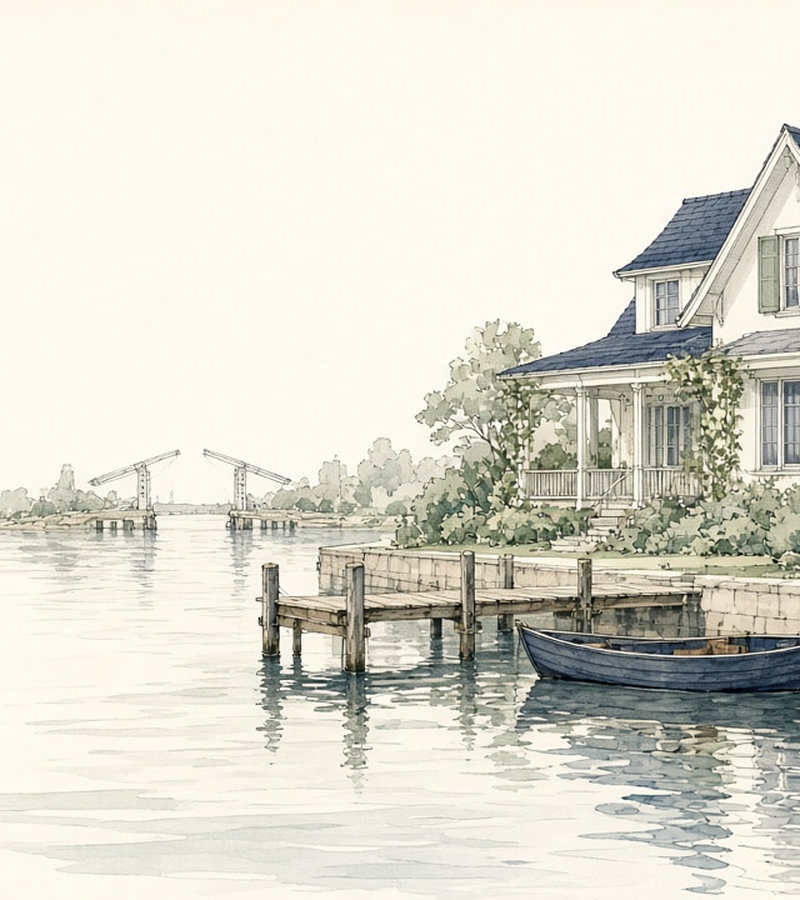
Two houses of the same size on the same isle can sit a few lots apart and price hundreds of thousands of dollars apart. Most of that gap sits on the water side of the lot: frontage, the route to the inlet, the seawall and the elevation certificate. Here is how it gets priced, and which documents let you set the number before a buyer's inspector does.
Our earlier piece, Waterfront Homes in Fort Lauderdale: What Buyers Should Know, takes the buyer's chair. This one is for owners setting a list price in Las Olas Isles, Rio Vista, Harbor Beach, Coral Ridge, Bay Colony, Lighthouse Point or elsewhere on the city's roughly 165 miles of waterways (city staff, Marine Advisory Board, September 2022).
How an appraiser turns water into dollars
There is no published Fort Lauderdale "waterfront premium" to multiply against your house. Appraisers isolate a feature with paired sales: closed sales alike except for that one feature, so the price difference measures it. Fannie Mae's Selling Guide (B4-1.3-09) requires adjustments that "reflect the market's reaction" and rejects rule-of-thumb figures; its own example contrasts a $20 per square foot shortcut with the $100 the market supported.
The buyer's appraiser will build an adjustment grid against your home. Build it first, with the right comparables, and decide which lines you can still change.
The five lines that move the grid
Frontage. Linear feet on the water, and what kind of water: a canal, a wide basin, the New River or the Intracoastal. Point lots with water on two or three sides form their own peer group.
The route to the inlet. A bascule bridge opens; a fixed bridge never does. The SE 17th Street (Brooks Memorial) Bridge on the Intracoastal has 55 feet of clearance closed and, since February 19, 2026, opens only on the hour during weekday rush periods (U.S. Coast Guard final rule, Federal Register, January 20, 2026). A fixed span caps the height of any boat that can reach your dock, which shrinks the group of buyers who will pay for that dock. Put the lowest fixed clearance on your route in the listing.
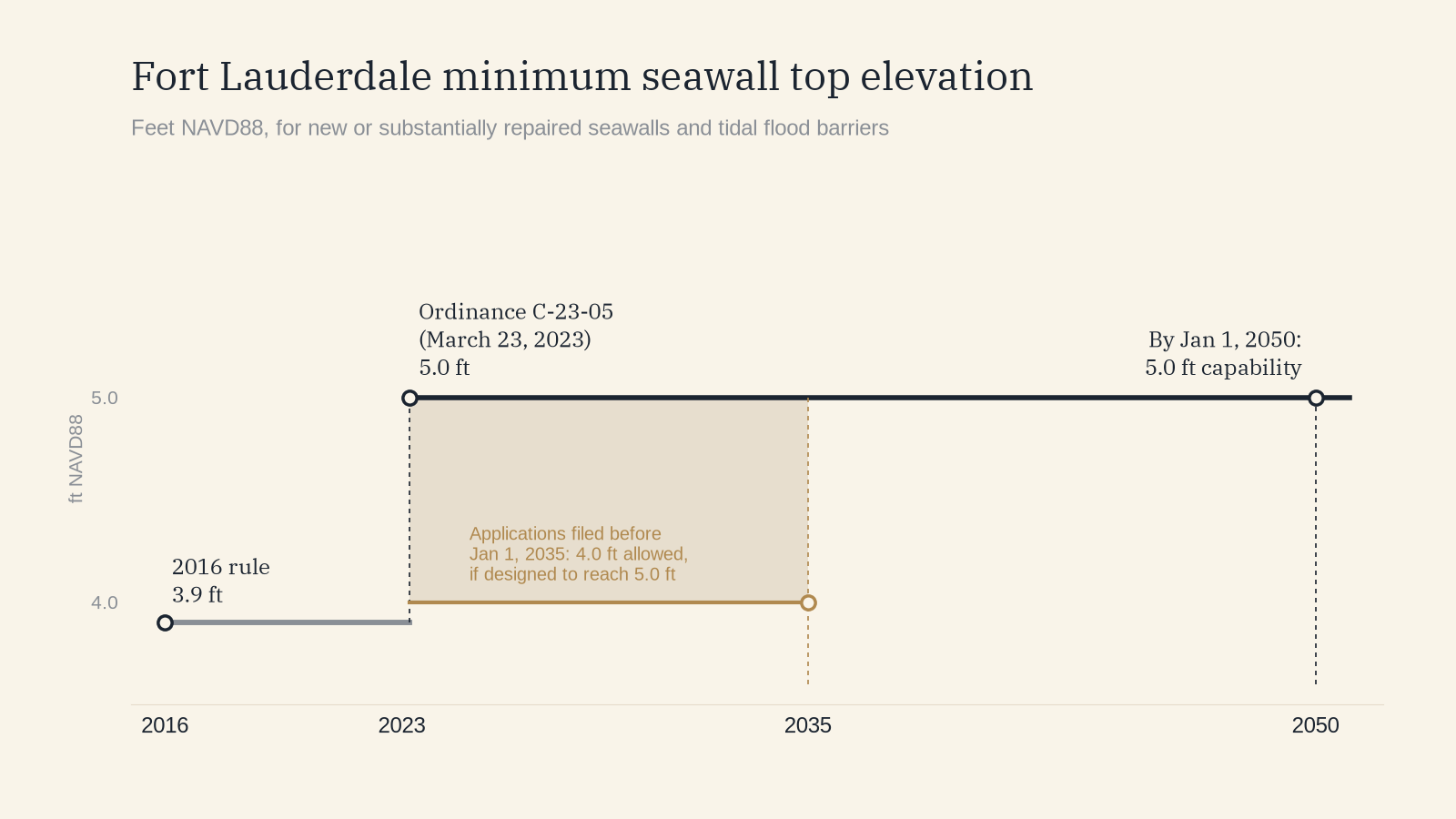
Seawall height and condition. Fort Lauderdale Ordinance C-23-05, adopted March 23, 2023, requires new or substantially repaired seawalls and other tidal flood barriers to reach a top elevation of 5.0 feet NAVD88. Applications filed before January 1, 2035 may be permitted at 4.0 feet if the wall is designed to reach 5.0 feet by January 1, 2050. Substantial means work along more than 50% of the shoreline, or work costing more than 50% of the wall's replacement cost. A wall cited for disrepair must be fixed within 365 days, and a substantial repair must meet the new height. The 2016 rule set 3.9 feet. Every contract for property in a tidally influenced area of the city signed after March 23, 2023 must carry a bold, capitalized disclosure about these standards, so inspectors ask for the cap elevation early.
Elevation and flood data. FEMA's current NFIP pricing (Risk Rating 2.0) rates each building on distance to flood sources, ground and first floor elevation, foundation type and cost to rebuild, so neighbors in the same zone can pay very different premiums. An NFIP building policy can be assigned to the buyer in writing when title transfers. Under section 689.302, Florida Statutes (in force since October 1, 2024, amended in 2025), you tell the buyer at or before signing whether you know of flood damage during your ownership, filed a flood claim, or received assistance for flood damage.
Dock and lift. Length, depth at low tide, lift capacity and permits on file. Unpermitted work is a line a buyer's attorney will find.
Hypothetical example: one comparable, one subject
Every number here is an assumption to show the arithmetic, not market data.
A comparable sold for $4,200,000 with 100 feet of frontage, no fixed bridge on its route and a seawall rebuilt to 5.0 feet NAVD88. The subject home matches it in size, age and finish, but has 80 feet of frontage, one fixed bridge on its route and an original seawall below the current standard, which a marine contractor quoted at $2,000 per linear foot to replace.
| Line | Comparable | Subject | Assumed deduction |
|---|---|---|---|
| Sale price | $4,200,000 | ||
| Frontage | 100 ft | 80 ft | 20 ft x $15,000 = $300,000 |
| Route to inlet | No fixed bridge | One fixed bridge | $250,000 |
| Seawall | Rebuilt to 5.0 ft | Original, quote on file | 80 ft x $2,000 = $160,000 |
| Indicated value | $3,490,000 |
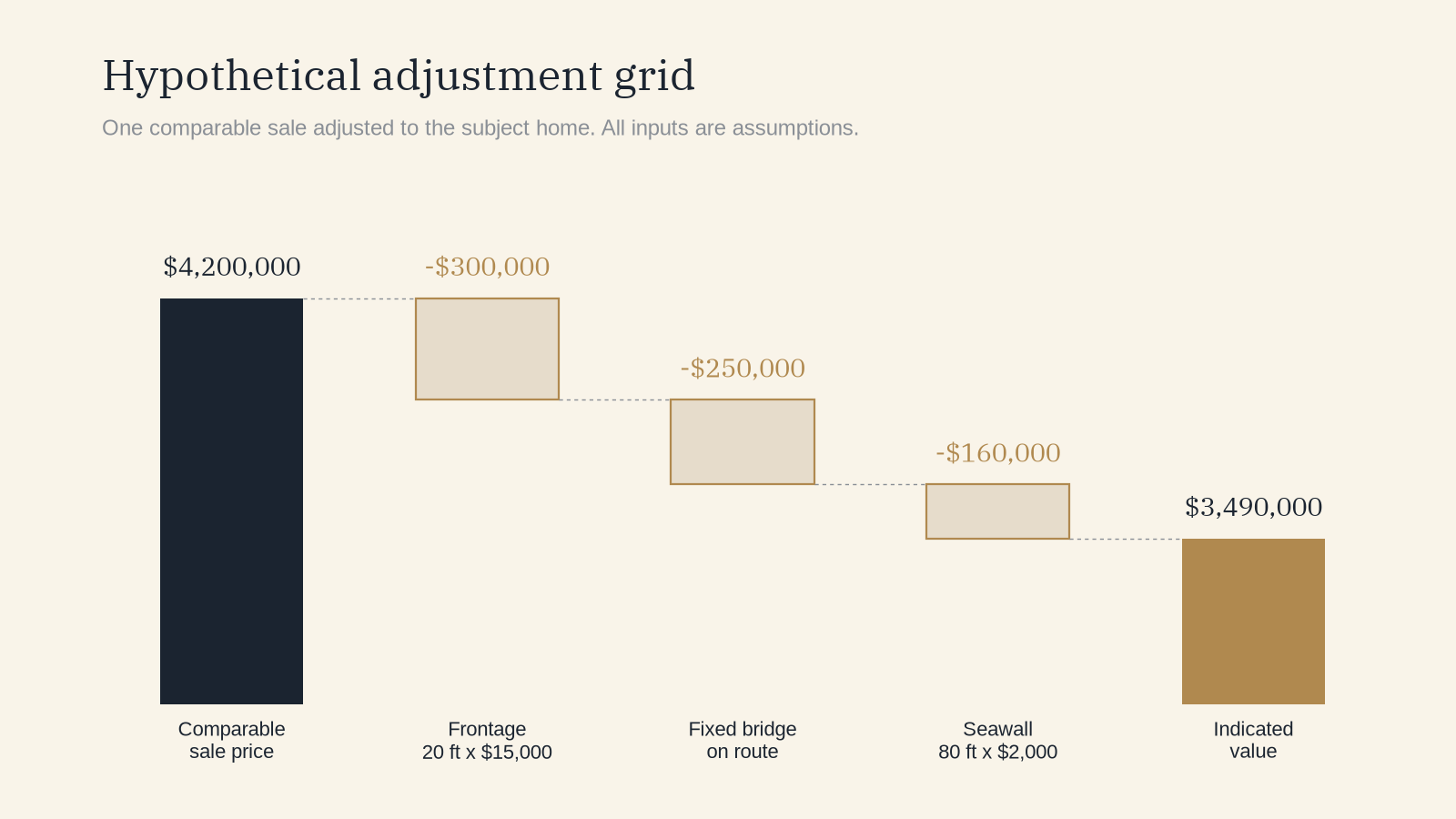
Two of the three deductions move with paperwork. Without a written seawall quote, a buyer substitutes a bigger number of their own. A buyer who hears the bridge clearance from you prices it once; one who discovers it on the water reopens the price. Frontage is fixed, so the lever there is choosing comparables with similar frontage.
On the same $3,490,000, Florida's documentary stamp tax on the deed, 70 cents per $100 under section 201.02, is $24,430. Who pays it is set in the contract; confirm with your closing attorney.
Pre-listing checklist for the water side
General steps are in our guide to selling a home in South Florida. This list covers the water.
- Seawall cap elevation in NAVD88 from a licensed surveyor, plus age and permits. Below 5.0 feet, get a written quote and ask whether the work counts as substantial.
- Elevation Certificate. The city keeps certificates filed with building permits and has a search for them; if none exists, a surveyor, architect or engineer prepares one on the FEMA form.
- Flood and windstorm declarations pages with current premiums, so a buyer can price carrying costs. Our insurance guide covers the wind side.
- Every bridge between your dock and the inlet, fixed or bascule, and the lowest fixed clearance.
- Dock and lift permits, lift capacity and depth at the dock at low tide, measured by your marine contractor.
- Your answers to the three questions on the state flood disclosure.
- Recorded sales for comparables from the Broward County Property Appraiser, sorted by frontage and route.
FAQ
Should I rebuild the seawall before listing? It depends on condition. A failing wall can be cited, with 365 days to repair. A sound but low wall can be handled with a written quote and permit-ready plans, so the work is priced in without a construction project during the sale. Ask your marine contractor and attorney.
Does no fixed bridge always add value? It adds value for buyers whose boats need the clearance. How much is a paired-sales question for your appraiser; no dated public source supports a percentage.
Is the property appraiser's just value my market value? Florida sets just value for the tax roll as of January 1 each year (section 192.042). Treat it as a starting point; recorded sales of similar waterfront homes carry more weight. Our property tax guide explains the bill.
Do I have to disclose a low seawall? In the city's tidally influenced areas the contract must include the tidal flood barrier disclosure, and state law requires the flood disclosure. Whether a specific defect must be disclosed is a question for your attorney.
Can my flood policy transfer to the buyer? An NFIP building policy can be assigned in writing when title transfers. FEMA excludes contents-only policies and buildings under construction. Private policies follow their own terms.
Get the grid before the buyer does
For owners of $1M+ waterfront homes in Fort Lauderdale, Lighthouse Point and nearby, we build this grid for your address: comparables matched on frontage and bridge route, a seawall and dock document list, and a written price range before you list. SunSt agents have closed more than $150M in combined volume. Book a home value check, see how we sell homes, or read the Fort Lauderdale neighborhood overview.