

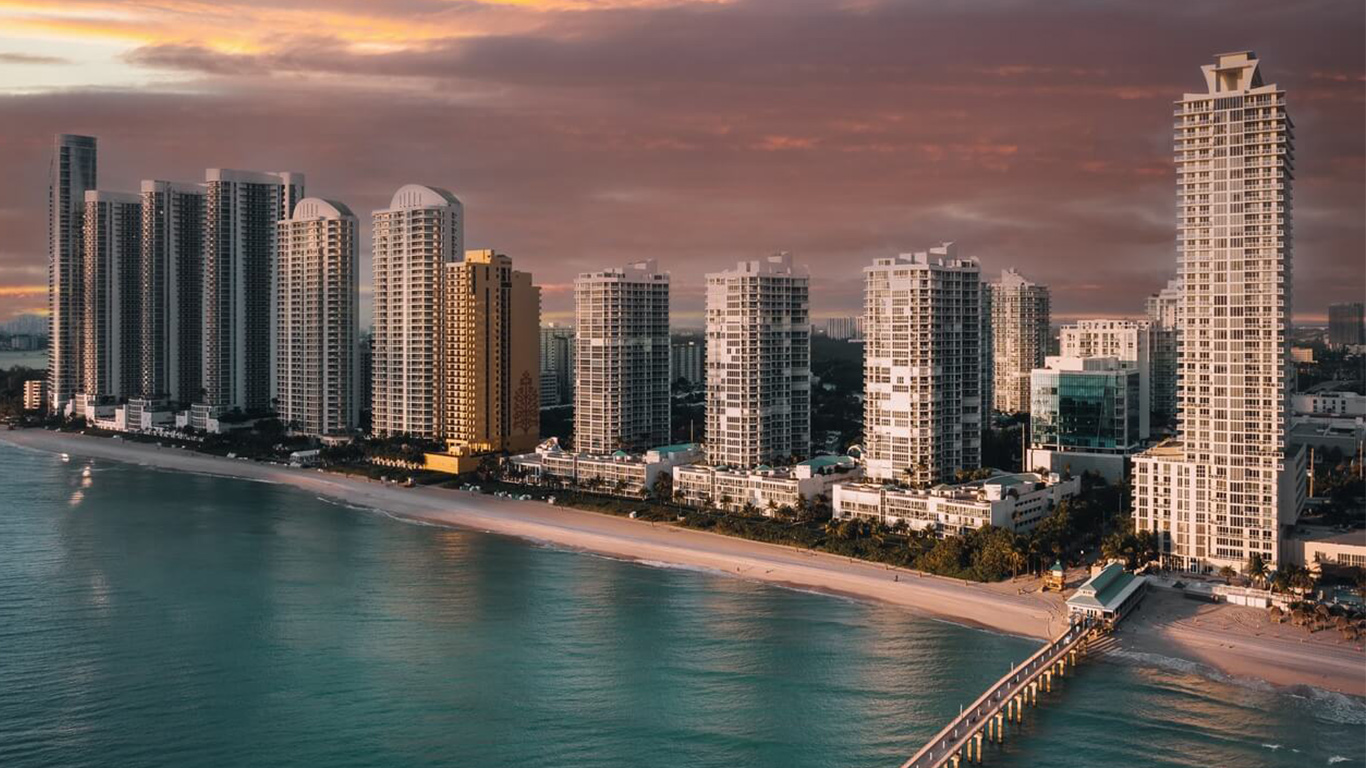
Sunny Isles Beach is a barrier-island city in northeast Miami-Dade County, developed almost entirely as oceanfront condominium towers. It carries the highest cost per square foot of any market SunSt covers, and the widest interval between its newest and oldest buildings.
The market
Sunny Isles Beach occupies the land between Collins Avenue and the Atlantic, and its economy consists of a single product: the oceanfront tower. Over the past two decades the city has been rebuilt vertically. The result is the most globally liquid residential market on this coast — one in which residences are acquired, held, and resold across international capital, and in which resale depth is itself a material component of value.
Beneath the newest towers sits an earlier stratum: buildings of the 1970s and early 1980s, frequently offering larger raw floor plates and lower cost per square foot, occupying oceanfront positions that could not be assembled today. That stratum is where the analytical work resides. A building of 1976 with a completed Milestone inspection, a funded reserve, and a direct-ocean residence approaching two thousand square feet may represent the strongest basis on the island. The same building with a waived reserve and an open inspection represents a liability with a view.
How value is set here
The band of cost per square foot in Sunny Isles Beach is bimodal, not continuous. Newer towers cluster near its upper bound. Pre-1985 buildings cluster near its lower bound. Very little trades between, because very little exists between.
The correct comparison is not cost per square foot. It is cost per square foot, plus capitalized association dues, plus the present value of known and probable structural assessments, over the intended holding period. A residence at the upper bound with fully funded reserves can outperform a residence at the lower bound carrying an unfunded structural project. We model this before an offer is written, and it has repeatedly changed the residence a client acquired.
What oceanfront costs
Association dues are not a running cost. They are part of the price. Capitalized across ten years, a difference of two thousand dollars per month is two hundred and forty thousand dollars of consideration.
The geography
Collins Avenue is the spine; effectively all inventory addresses from it. Buildings are best understood by vintage cohort — pre-1985, 1985 to 2005, and post-2005 — rather than by name, because the cohort determines the obligation and the obligation determines the price.
On this island, the interval between the strongest and weakest association is worth more than the interval between the finest and plainest view. The following is how we measure it.
The four documents that decide a Florida condominium purchase
Since Florida's 2022 building-safety reforms and their 2025 amendments under House Bill 913, acquiring a condominium here means underwriting an association, not merely a residence. The Milestone Inspection — required for buildings of three or more habitable stories upon reaching thirty years of age, and every ten years thereafter. The Structural Integrity Reserve Study — unit-owner-controlled associations existing on or before July 1, 2022 were required to complete a SIRS by December 31, 2025; where a Milestone Inspection falls due on or before December 31, 2026 the two may run concurrently, but the SIRS may not be completed after December 31, 2026. The insurance consequence — an association out of compliance is ineligible for Citizens Property Insurance. The lease provisions — minimum terms and occupancy limits vary building to building. Before a client writes an offer, we obtain the Milestone report, the SIRS and funding plan, twenty-four months of minutes, the budget, and the reserve balance, and return an exposure figure in dollars. This is the analysis institutional buyers commission at nine figures. We perform it at seven and eight.Statutory references: Fla. Stat. §553.899; §718.112(2)(g); Florida HB 913 (2025). General information, not legal advice.
How we represent buyers →